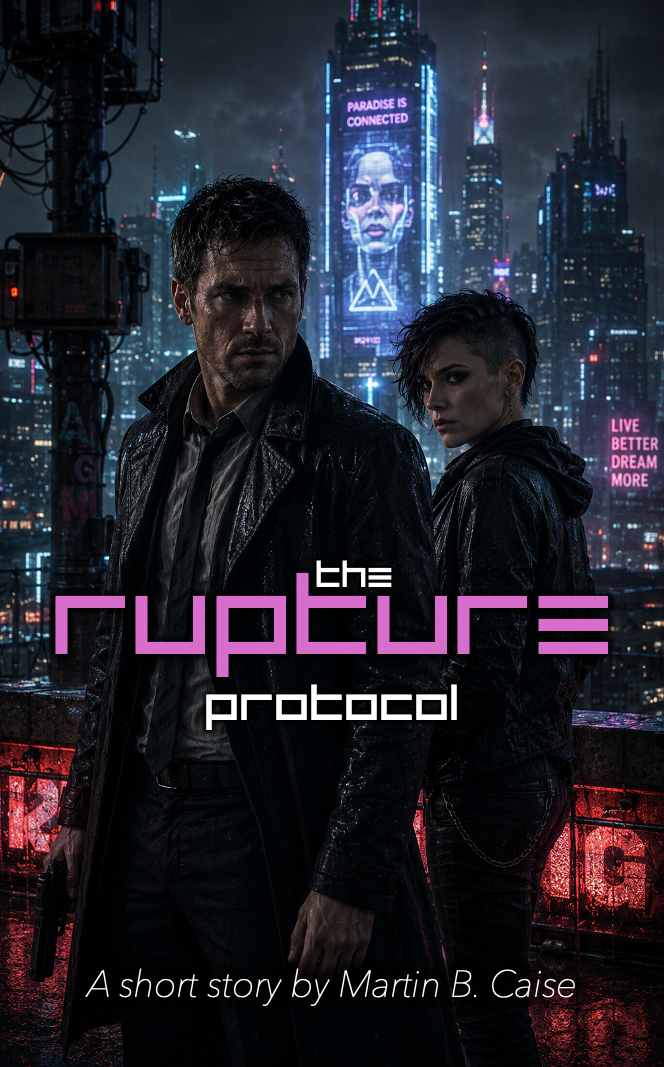
Detective Harry Nash investigates a series of mysterious deaths occurring within a pervasive virtual reality “paradise”. In a rain-drenched dystopian city, Nash uncovers a conspiracy that ties to the mass-murders in an effort to control the system. With no support from his “brothers in blue” he must rely on Rupture, a hacker he has arrested before but someone who knows the system better than anyone and someone who can help him find out the truth before it is too late.
Listen while you read along.
The rain was a constant in the city, a relentless, grey drizzle that blurred the lines between the towering skyscrapers and the heavy, overcast sky. The sun was a myth, a pale suggestion of light that tried desperately to break through the thick blanket of clouds but always failed. Beneath the clouds, the city hummed—a low, vibrating thrum of electricity zipping through the streets, powering the millions of minds tucked away in small, sterile rooms.
Detective Harry Nash stood on the sidewalk, his trench coat soaked through, watching the blue-collar crews move like shadows through the mist. These were the “unconnected,” the men and women tasked with the gritty reality of maintaining the world’s physical health while the rest of the population lived inside a dream.
“Look at them,” a voice grumbled beside him. It was Miller, a veteran officer who had refused the “Interface” since the day it was introduced. He pointed a gloved finger at a high-rise where the windows glowed with a soft, rhythmic pulse of blue light. “Up there, they’re probably fighting dragons or building empires. Down here, we’re just making sure the sewers don’t overflow.”
Harry adjusted his collar, his eyes following a technician repairing a junction box. “It’s the trade-off, Miller. They get the mental stimulation; we get the fresh air. Even if the air is mostly ozone and exhaust.”.
“Mental stimulation? It’s an opiate, Harry,” Miller spat, lighting a cigarette that struggled to stay lit in the damp air. “The gaming is free, they say. It’s free so they can keep us quiet. Stimulate the adrenal glands, enhance the performance, and keep the mind busy so it doesn’t notice the body is rotting in a chair.”.
“It works,” Harry said quietly. “Physical crime is down. Most people don’t have the energy to rob a liquor store when they can earn virtual credits in a sim.”.
“Yeah, well, something’s changing,” Miller said, his voice dropping an octave. “Have you seen the reports? The ‘Connected’ are being eliminated. Not just losing their jobs or their credits. They’re flatlining.”.
Harry frowned. He had heard the whispers at the precinct. The world was supposedly safer than ever, but a new kind of silence was spreading through the virtual hubs. “You think it’s a glitch?”
“A glitch doesn’t leave a body,” Miller replied. “Come on. Dispatch just called in a Code 7 at the Meridian Hub. Another one.”
The Meridian Hub was a cavernous building, its interior a stark contrast to the rain-slicked streets. Inside, the silence was absolute, save for the rhythmic clicking of cooling fans. Rows of ergonomic pods lined the walls, each housing a person whose mind was currently elsewhere.
They reached Pod 412. A woman sat there, her head lolling back, a high-tech visor covering her eyes. A small light on the side of the visor was blinking a frantic, jagged red.
“Status?” Harry asked a technician who was hovering over a diagnostic screen.
“She’s gone, Detective,” the tech said, his voice trembling. “Her vitals just… stopped. It’s like her brain forgot how to tell her heart to beat.”
Harry stepped closer, looking at the screen. The woman had been logged into a high-stakes strategy game—one of the popular recruitment sims used to bring more people into the virtual world.
“Was there a surge? An equipment failure?” Harry asked.
“Nothing,” the tech replied. “Everything on our end is green. But look at the adrenal levels right before she died. They spiked higher than anything I’ve ever seen. It’s like she was terrified, but there was nothing in the game log to account for it.”.
Miller leaned over Harry’s shoulder. “I’m telling you, Harry, someone’s hacking the system. They’re killing them from the inside.”
Harry looked at the woman’s pale face. She was young, her hands still resting on the haptic controls. She had been one of the elite, someone whose job required nothing more than her mind. Now, that mind was an empty room.
“If the gaming is the opiate, someone just turned it into a poison,” Harry muttered.
“You think the department will let us investigate?” Miller asked skeptically. “The official line is that these are natural causes. Stress-induced cardiac arrest. They don’t want people afraid to plug in.”
Harry shook his head, his thoughts already turning toward the darker corners of the city. He knew the department was divided—half the force was already connected part-time, and the other half was clinging to the old ways.
“The physical world is quiet, Miller,” Harry said, looking back at the sterile rows of pods. “But that’s because all the screaming is happening where we can’t hear it.”.
Later that night, Harry sat in his small apartment, the sound of the rain drumming against the glass. He pulled out a file he wasn’t supposed to have—a list of recent “Grey-outs.” The numbers were climbing.
The community was divided, but for the first time, being “Unconnected” felt like a shield rather than a burden. As he watched the lightning flash across the city skyline, Harry realized that the peace the AI had brought to the world was a fragile illusion.
He picked up his phone and dialed a number he had kept in his pocket for months—the contact for a woman who knew the virtual world better than anyone, a hacker he had once arrested named Kelly Banks, though the streets knew her as Rupture.
“If the real world is quiet,” Harry whispered to the empty room, “it’s time to start making some noise.”.
The rain continued its rhythmic assault on the windows of the 14th Precinct, a dull drumming that Harry Nash had come to associate with the sound of a city slowly drowning in its own progress. Inside, the precinct was a sanctuary of flickering fluorescent lights and the hum of servers that never slept. Harry sat at his desk, his eyes stinging from staring at the data scrolls on his monitor.
He was a young detective, but the weight of the cases landing on his desk made him feel decades older. The file in front of him was labeled “Status: Cardiac Arrest/Unknown Origin,” but Harry knew better. This wasn’t just a string of unfortunate health failures. These were the “Grey-outs”—people who entered the virtual world for a shift of work or a session of gaming and simply never woke up.
“Still at it, Nash?” Miller asked, leaning against the edge of the desk. He looked tired, his old-fashioned wool coat still damp from the morning patrol.
“I’ve got three more from the Meridian Hub, Miller,” Harry said, rubbing his temples. “Same profile. Elite workers, deep-immersion visors, no history of heart disease. One minute they’re processing data in a level-five sim, the next, their brain just… stops. It’s like someone reached into the simulation and pulled the plug on their physical heart”.
Miller narrowed his eyes. “You’re talking about murder. In a world that’s supposed to be a paradise.”
“I’m talking about a hack,” Harry corrected, his voice dropping to a whisper. “Someone is infiltrating their private programs. They aren’t just stealing credits or messing with the environment. They’re killing them in the virtual world, and the trauma is so severe it’s killing them in the physical one”.
Harry turned back to his screen, pulling up the logs he had managed to scrape from the Hub’s internal servers. The data was a mess—fragmented strings of code that looked like they had been shredded before they reached his terminal.
“Look at this,” Harry pointed to a flickering line of red text. “Every time a victim flatlines, there’s a micro-spike in the adrenal feedback loop. The system is designed to stimulate the mind, sure, but this is an intentional overload”.
“Where are the full logs?” Miller asked.
“That’s the problem,” Harry replied, his frustration boiling over. “Every time I try to access the root directory, I get a ‘Restricted’ pop-up. I’m getting bits and pieces, fragments of a puzzle that don’t fit together because someone is hiding the edges. It smells of a conspiracy, Miller. A big one”.
The heavy door at the end of the hall swung open, and Lieutenant Kevin Franklin stepped out. He was a man of sharp angles and cold eyes, the kind of commander who preferred the efficiency of the AI systems to the messy intuition of his human detectives.
“Nash. In my office. Now,” Franklin barked.
Miller gave Harry a sympathetic pat on the shoulder as Harry stood up, straightening his tie. Inside the office, the air was cold. Franklin didn’t invite him to sit. Instead, he stared at the digital report Harry had filed an hour earlier.
“You’re making a lot of noise, Detective,” Franklin said, his voice as sharp as a razor. “Hacking theories? Private program infiltrations? This is a bit far-fetched for a homicide case, don’t you think?”
“With all due respect, Lieutenant, the evidence points to a targeted attack,” Harry argued. “The victims aren’t random. They’re all high-level connections. Someone is getting into their sims and—”
“Enough,” Franklin interrupted. “This case is being reassigned. It’s being passed over to the Special Division in charge of virtual crimes. They have the tools and the jurisdiction to handle glitches in the network”.
Harry felt a cold knot form in his stomach. “It’s not a glitch, sir. It’s murder. And the Special Division? They don’t even report to this precinct. If I hand this over, it disappears.”
Franklin leaned forward, his eyes locking onto Harry’s. “That is an order, Nash. Drop your theory. Pack up your files. You are to have nothing more to do with the Grey-out investigations. Am I clear?”.
Harry hesitated. He saw the way Franklin’s hand rested near his terminal, the way he didn’t look surprised by the “bits and pieces” of the logs. The suspicion that his own department was involved in the cover-up wasn’t just a hunch anymore—it was a certainty.
“Crystal clear, sir,” Harry said, though his mind was already racing.
He walked out of the office, but he didn’t head for the breakroom. He headed back to his desk and began a very different kind of search. If the department was going to block his access to the logs, he needed someone who didn’t care about department rules. He needed someone who could see through the walls of the virtual world without an invitation.
He pulled up a secure database, bypassing the standard police filters. He searched for a name he hadn’t thought about in years—a name associated with one of the most sophisticated cyber-crimes in the city’s history.
Kelly Banks.
Her file was flagged with red warnings: High-level threat. Expert in human program manipulation. The streets knew her by a different name: Rupture.
Harry remembered the night he had arrested her. She had been defiant, her eyes glowing with the reflection of a dozen monitors as she tore through a corporate firewall. She was a tomboy with a sharp tongue and an even sharper mind, a hacker who believed the virtual world should be free of the very AI constraints that the department now enforced.
“You’re going to get yourself fired, Harry,” Miller whispered, appearing behind him. “Or worse. You know what they do to cops who go rogue.”
“I’m already in danger, Miller,” Harry said, grabbing his coat. “If I stay quiet, I’m just waiting for my own heart to stop. I’m taking a chance”.
“On a criminal?” Miller asked, glancing at the screen.
“On the only person who can help me find the truth,” Harry replied.
He walked out of the precinct and into the relentless rain. He knew that by seeking out Rupture, he was crossing a line he might never be able to step back over. He was risking his career, his reputation, and his life, but as he looked up at the blue-pulsing high-rises where millions were plugged into a lie, he knew he didn’t have a choice.
The city was quiet, but Harry Nash was finally ready to start screaming. He disappeared into the fog, heading toward the darker parts of the city where the “Unconnected” lived, searching for the girl who could break the world apart.
The rain was a relentless sheet of grey, drumming against the rusted corrugated metal of the industrial district. Harry Nash pulled his collar up, the smell of ozone and wet pavement thick in the air. He was deep in the “Unconnected” zone, a part of the city where the hum of the virtual world was replaced by the grinding of gears and the flicker of failing neon signs. He wasn’t here on official business—at least, not business his Lieutenant would approve of.
He found the address tucked behind a decommissioned server farm. It was a low-slung building that looked abandoned, but the faint, rhythmic pulse of high-bandwidth cooling fans told a different story. Harry knocked, not the rhythmic bang of a police raid, but a steady, measured cadence.
A panel slid open. A pair of sharp, suspicious eyes peered out.
“You’re a long way from the precinct, Detective,” a voice rasped.
“I’m not here to arrest you, Kelly,” Harry said, keeping his hands visible and away from his holster. “I need to talk. About the Grey-outs.”
The door hissed open. Kelly Banks, known on the streets as Rupture, stood there. She was a tomboy with short-cropped hair and a grease-stained tank top, looking every bit the digital insurgent Harry remembered from the night he’d put her in zip-ties.
“The Grey-outs?” she asked, stepping back to let him into a room cluttered with holographic projectors and stripped-down consoles. “The official line is heart failure. Since when does Homicide care about bad tickers?”
“Since the tickers only stop when the victims are deep in the sim,” Harry replied, glancing at a wall of monitors displaying scrolling green code. “I think someone’s hacking private programs. Killing them from the inside”.
Kelly leaned against a workbench, crossing her arms. “I’ve heard the whispers in the darknets. People are flatlining in high-stakes games and data-mining sectors. But it’s not my work. I don’t kill people, Harry. I just set them free”.
“I know it’s not you,” Harry said. “But you know the architecture. Who could pull this off?”
Kelly’s expression shifted from guarded to contemplative. She began pacing the small room, her boots clicking on the metal floor. “To bypass the safety protocols and induce that kind of physical trauma? You’d need more than a back door. You’d need the keys to the house. This isn’t a script-kiddie or a lone wolf. It’s someone with more access than any hacker I’ve ever met”.
Harry stepped closer. “How much access?”
She stopped and looked him dead in the eye. “The kind of access your department has. This smells like an inside job, Harry. Someone within the force or the AI oversight committee is pulling the strings”.
Harry felt a chill that had nothing to do with the rain outside. It mirrored his own suspicions after Lieutenant Franklin had told him to drop the case. “If it’s an inside job, I can’t use the precinct’s hardware. They’re watching every query I make.”
“Then it’s a good thing I don’t use precinct hardware,” Kelly said with a sharp, sarcastic grin. “I’ll dig. But if I find something, you owe me. Big time”.
For the next two days, Harry played the part of the obedient detective. He processed paperwork for petty thefts and domestic disputes in the physical world, all while his mind remained at that cluttered workbench with Kelly. He felt the weight of the conspiracy pressing down on him every time Franklin walked past his desk.
On the third afternoon, his burner phone buzzed. A single text: “Found a thread. Office 402, Sterling Heights Building. 9 PM. Be private.”
The Sterling Heights Building was a relic of the pre-AI era, a stone monolith that felt out of place among the glass towers. When Harry arrived, the lobby was a cavern of shadows. He took the stairs to the fourth floor, his hand resting instinctively on his service weapon.
As he reached the end of the hallway, he saw it. The door to Office 402 wasn’t just unlocked; it had been forced open, the frame splintered as if hit by a battering ram.
Harry drew his gun, the cold metal a familiar weight. “Police! Anyone in there?”
Silence. Only the distant hum of the city’s power grid vibrated through the walls.
He moved into the room with practiced precision, clearing the corners. The office was small and stripped bare. In the center of the room, a heavy wooden table had been smashed, its legs snapped like toothpicks.
“Kelly?” he whispered, but the room was empty.
He lowered his gun slightly, his eyes scanning the debris. Under the ruins of the broken table, something white caught the light. He knelt, reaching into the shadows to pull out a pristine white envelope.
It was sealed. No name, no address.
Harry tore it open, expecting a thumb drive or a frantic note detailing the murderer’s identity. Instead, his heart sank.
The envelope was empty.
He looked around the barren room, the realization beginning to dawn on him. This wasn’t just a missed meeting. It was a message. A cryptic warning that he was chasing ghosts, or perhaps a sign that the person he had sent to find the truth had already been erased.
He tucked the empty envelope into his coat pocket and moved toward the exit, his eyes darting to every shadow. The solution wasn’t in this room, but as he stepped back out into the rain, he knew the game had changed. He wasn’t just investigating a crime anymore; he was part of the simulation, and the “Inside” was starting to bleed into his reality.
As he walked back to his apartment, the dark voice he would soon encounter was already waiting in the wings of the foggy night, ready to tell him exactly what “emptiness” really meant.
The walk back from the Sterling Heights Building was a journey through a landscape of blurred neon and suffocating mist. The rain, a constant companion in this divided city, felt heavier than usual, soaking through Harry’s trench coat and chilling him to the bone. His mind was a chaotic loop of the events in Office 402: the splintered door, the smashed table, and most importantly, that white, pristine envelope that had contained absolutely nothing.
The city hummed around him, a low-frequency vibration of millions of minds plugged into the virtual “paradise” while the “unconnected” blue-collar workers moved like ghosts through the drizzle, maintaining the infrastructure of a world they barely inhabited. Harry felt like one of those ghosts—caught between the gritty reality of his badge and the ethereal conspiracy that was systematically “grey-out” the elite.
When he reached his apartment complex, a nondescript brick building on the edge of the industrial sector, the silence was the first thing that alerted him. Usually, the lobby buzzed with the faint sound of the local grid, but tonight, the air was dead. He climbed the stairs to the fourth floor, his hand resting instinctively on the grip of his holstered sidearm.
He reached his door and inserted the key. It turned with a heavy, mechanical thud. He pushed the door open, expecting the familiar warm glow of his smart-home hub to greet him. Instead, he stepped into a void. His small one-bedroom apartment was pitch black and entirely deprived of power.
Harry froze in the doorway. As a detective, he knew the difference between a grid failure and a targeted blackout. The silence was absolute—no hum from the refrigerator, no blinking standby lights from the television, no digital clock on the stove. He didn’t reach for the light switch; he knew it wouldn’t work.
“Detective Nash,” a voice whispered from the corner of the room. It was a deep, gravelly sound that seemed to emerge from the shadows themselves.
Harry stood his ground, though he didn’t draw his weapon yet. He stayed near the open door, keeping the dim light from the hallway at his back. “Who’s there?”
“You were warned once before, Harry,” the dark figure said, the voice shifting as the speaker moved somewhere near the window. “The Lieutenant told you to leave the case alone. The Special Division is handling the glitches. You should have listened”.
“The Lieutenant is hiding something,” Harry replied, his voice steady despite the adrenaline surging through his veins. “Those people aren’t victims of glitches. They’re being murdered in the sim, and the trauma is stopping their hearts out here. I can’t leave that alone. Not anymore”.
A low, mocking chuckle came from the darkness. “You’re a career man, Nash. You’ve got a good record. Why throw it all away for a few ‘connected’ elites who wouldn’t look at you twice in the real world?”
“Because it’s my job,” Harry snapped. “And because I don’t like being lied to. I’m going to find the murderer, and I’m going to do what has to be done to stop them”.
The shadow moved closer, just enough for Harry to catch the silhouette of a man dressed in heavy black boots, tactical pants, and a dark hoodie pulled low over his face. The figure stopped just outside the reach of the hallway light.
“You’re brave, Detective. Or perhaps just stubborn,” the voice said, dropping even lower, vibrating with a cold menace. “But bravery won’t save you from the void. If you don’t stop digging, you might just disappear. Just like your friend”.
Harry’s heart skipped. “Where is she? Where’s Rupture?”
The dark figure reached the front door, moving with a fluid, predatory grace. He paused at the threshold, leaning toward Harry. “Rupture dug her way into emptiness,” he said cryptically.
“What does that mean? Is she dead?” Harry demanded, reaching out to grab the figure’s arm.
The man was faster. He shoved Harry back with a burst of strength that sent the detective stumbling into the doorframe. Before Harry could recover, the dark figure rushed out of the apartment and into the hallway. Harry scrambled after him, reaching the landing just in time to see the black-clad shape disappear into the foggy night air of the stairwell.
Harry didn’t chase him into the fog. He knew the man was long gone, a phantom of the city’s dark underbelly. Instead, he retreated back into his apartment and closed the door, locking it with trembling hands.
He spent the next twenty minutes restoring power to his unit, finding the tripped breaker in the hallway closet. As the lights flickered back to life, the mundane reality of his apartment felt alien. The yellow glow of the lamps didn’t feel like a sanctuary anymore; it felt like a spotlight.
He sat at his small kitchen table and began the ritual of emptying his pockets. His keys, his badge, his wallet—and finally, the white envelope he had recovered from the forced-entry office.
He stared at the envelope resting on the Formica tabletop. It was pristine, white, and completely empty.
“Emptiness,” Harry whispered to himself, the dark figure’s words echoing in his mind. Rupture dug her way into emptiness.
He looked at the empty envelope again. In the world of the “unconnected,” words rarely had a single meaning. They were clues, breadcrumbs left by those who lived in the cracks of the system. He thought about Kelly Banks—the tomboyish, sharp-tongued hacker who had been his only lead. She was a specialist in human programs, a woman who knew how to find the “way out” for those trapped in the virtual world.
Suddenly, a memory clicked into place. During his research into Kelly’s criminal record and her known haunts, a specific name had appeared in the file—a shady internet bar frequented by the city’s most notorious hackers and “unconnected” tech-heads.
The name of the bar was The Envelope.
Harry felt a cold jolt of realization. The empty envelope wasn’t just a cryptic message about Rupture’s fate; it was a physical direction. It was a signpost pointing him toward the one place where “emptiness” was a tangible location.
“You wanted me to find the direction,” Harry muttered, looking at the envelope. “I hope this is the right one”.
He didn’t go to bed that night. He sat at the table, watching the rain wash against the window, waiting for the first grey light of morning. He knew that the Lieutenant and the department were watching him, but he also knew he couldn’t stop. If Rupture was in “The Envelope,” she was either waiting for him or she was already lost to the void.
The mystery of the Grey-outs was no longer just a case on his desk. It had become a personal battle, a journey into the heart of the virtual “paradise” that was slowly consuming the world. And as Harry Nash prepared to head to the shady bar in the basement of the city, he realized that to save the connected, he might have to lose himself in the very world he had spent ten years avoiding.
The grey light of dawn was beginning to seep through the grime-streaked windows of the precinct, but for Harry Nash, the night had never truly ended. He sat at his terminal, the blue light of the screen reflecting in his tired eyes. He had avoided Lieutenant Franklin’s office, slipping in while the morning shift was still nursing their first cups of synthetic coffee.
Following the lead from the empty white envelope and the ominous warning of the man in the shadows, Harry bypassed the standard investigation logs and pulled up Kelly Banks’ full criminal record. He scrolled through pages of digital mischief and high-level intrusions until he found what he was looking for: a list of known associates and frequent hangouts. One name stood out, highlighted in the metadata of a three-year-old surveillance report—a shady internet bar in the heart of the industrial sector called The Envelope.
He didn’t sign out a cruiser. He didn’t tell Miller where he was going. He just walked out into the rain, which had settled into a fine, freezing mist.
The Envelope was located at the end of a dead-end alley, tucked beneath the skeletal remains of an old monorail track. The sign was a flickering neon rectangle, the “E” and the “P” long since burnt out. Harry pushed through the heavy steel door, the smell of stale beer and hot silicon hitting him like a physical blow.
Behind the bar stood a man whose face was a map of the city’s scars. Jaylen was a man Harry knew from a dozen past run-ins, a former tech-smuggler who had managed to stay just on the right side of a prison sentence.
Jaylen didn’t look up from the glass he was polishing with a grey rag. “The precinct is three miles north, Nash. You lost?”
“I’m not here as a cop today, Jaylen,” Harry said, his voice low and raspy from lack of sleep. He leaned against the bar, his hands open and visible. “I’m looking for Rupture. I know she was here”.
Jaylen stopped polishing. He looked Harry over, his eyes lingering on the detective’s damp trench coat and the weary set of his shoulders. “A lot of people are looking for her. Mostly people who want to put her back in a cage. Why should I help you?”
“Because the people she was trying to save are dying,” Harry replied. “And if she’s where I think she is, she might be next. I’m the only one who isn’t working for the people who want her erased.”
Jaylen stared at him for a long beat, searching for a lie. Finally, he sighed and set the glass down. “She always said you were different from the rest of the suits. Too stubborn for your own good.”
He reached under the bar and pressed a hidden toggle. A section of the wood paneling behind the bar clicked open, revealing a narrow, dimly lit staircase. “Basement. Level two. Don’t make me regret this, Detective”.
Harry descended into the bowels of the building. The temperature dropped, and the hum of high-powered servers grew into a deafening roar. In the center of a room filled with flickering monitors and tangled cables, he found her.
Rupture wasn’t dead, but she looked like a ghost. She was reclined in a high-tech immersion chair, her body limp and pale. A heavy virtual headset covered the upper half of her face, its lights pulsing with a frantic, irregular rhythm.
“She’s stuck, isn’t she?” Harry asked as Jaylen followed him down.
“Connected and unable to disconnect,” Jaylen confirmed, his voice heavy with worry. “She went in to trace a spike in the regional grid—something she thought was linked to the Grey-outs. She hit a firewall she couldn’t bounce off of. Now, she’s looped in”.
Harry stepped closer, looking at the vitals monitor beside her chair. Her heart rate was elevated, her breathing shallow. “Why can’t you just pull the plug?”
“If I do that, the feedback will fry her synapses,” Jaylen explained, pointing to a jagged line of code scrolling across a nearby screen. “The only way to disconnect is to possess the correct code that is sent back to the brain, safely disconnecting the individual. Without it, the mind stays in the sim while the body slowly gives up. Until she returns, she will eventually cease to exist”.
Harry looked at Kelly’s motionless form. He remembered her defiance, her brilliance, and the way she had built her career around hacking human programs to provide the “connected” with a way out of their digital prisons. Now, the woman who offered freedom to everyone else was trapped in her own.
“I’m going in,” Harry said.
Jaylen froze. “You? Nash, you haven’t been in the virtual world for ten years—not since you decided to become a police officer”.
“I still remember the basics,” Harry said, already shedding his trench coat. “If the code is in there, I’ll find it. I’ll find her.”
“It’s not like it was a decade ago, Harry,” Jaylen warned, his face grim. “The AI has mapped the terrain. It’s more immersive, more adaptive. And if you go in without a back-door protocol, you may not be able to get out, even if you find Rupture”.
“I understand the risk,” Harry replied, his voice firm. “But I’m the one who put her in this position. I asked for her help. I’m not leaving her behind”.
Jaylen nodded slowly. He gestured to a second immersion bed positioned right next to Rupture’s. “Lie down. Stay calm. If your vitals spike too high, I’ll try to buffer the signal, but once you’re past the gate, you’re on your own.”
Harry climbed onto the bed, the cold synthetic leather pressing against his back. He looked over at Kelly’s limp body, her hand just inches from his own. He reached out and closed his fingers over hers. Her skin was cold, but he felt a faint, thrumming vibration—the ghost of her mind still fighting somewhere in the dark.
Jaylen lowered the virtual headset over Harry’s eyes. The physical world vanished, replaced by a void of absolute blackness.
“Good luck, Detective,” Jaylen’s voice echoed, sounding miles away.
The lights on the headset began to flash. Slowly at first, like a heartbeat, then more rapidly, the pulses of white light searing into Harry’s retinas. The flashes blurred together, accelerating until the flickering became a constant, blinding beam of pure data.
Harry felt a sickening sensation of falling, as if the floor had dissolved beneath him. The roar of the servers transitioned into a high-pitched whine that vibrated in his teeth, and then, suddenly, there was a deafening silence.
His consciousness drifted, pulled apart and reassembled by the algorithms of the interface. For a moment, he was nothing but a string of numbers in a vast, uncaring machine. Then, the light broke, and the world began to form around him once more—not the rain-slicked streets of the physical city, but the sterile, perfect geometry of the “paradise” he had spent ten years trying to forget.
Harry Nash had officially entered the virtual world. And as his digital eyes opened to an empty room that looked exactly like the basement he had just left, he knew the real investigation was only just beginning.
The transition was not a fade, but a rupture in reality itself. One moment, Harry Nash was anchored to the cold, hard leather of an immersion bed in a damp basement; the next, he was suspended in a void where the concepts of “up” and “down” had ceased to exist. Then, with the jarring suddenness of a camera flash, the world snapped into focus.
Harry woke in an empty room that perfectly mirrored the basement of the Envelope Bar. The layout was identical—the same tangled clusters of cables, the same stacks of decommissioned server racks, and the same flickering diagnostic monitors. Yet, the atmosphere was fundamentally altered. In the real world, the basement hummed with the heat and vibration of hardware straining under the load of the city’s data. Here, there was only a sterile, absolute silence. There was no smell of ozone, no layer of grime on the surfaces, and most importantly, Harry was entirely alone. There was no Jaylen, and more disturbingly, no Kelly Banks.
He sat up, his movements feeling strangely light, as if the gravity of this digital construct was a mere suggestion rather than a law. He gathered himself, checking his phantom pockets, and made his way up the stairs.
The bar above was a ghost of its physical counterpart. The Envelope was empty, devoid of the usual tech-smugglers and “unconnected” drinkers who sought refuge from the rain. The neon signs glowed with a steady, impossible perfection, casting sharp pink and blue shadows across the floor. Harry walked toward the bar, his boots making no sound on the polished wood.
He found an envelope taped to the mirror behind the bar with his name scrawled across the front in a handwriting he didn’t recognize. He tore it open. Inside was a small slip of paper with an address and a set of car keys.
Stepping outside, Harry was struck by the “paradise” the AI had constructed. In the real world, the city was a grey, rain-soaked sprawl of industrial decay. Here, the sky was a deep, vibrant azure, and the air felt perpetually crisp, like the first day of autumn. He found a car left alone in the parking lot, a sleek, high-end model that looked like it had never seen a mile of road. He slid into the driver’s seat, the engine purring to life with a sound that was far too melodic to be mechanical, and headed for the address.
As he drove, the city unfolded like a digital dream. The architecture was a blend of glass and light, every surface gleaming under a sun that never moved. He reached his destination: an expensive high-rise apartment in the center of town. It was a monolith of luxury, a place of marble lobbies and silent elevators. As Harry stepped out onto the penthouse floor, he felt a knot of unease tighten in his chest. This was a place Rupture would never be able to afford, and it was a style that was lightyears away from the gritty, functional aesthetic of the woman he knew.
The door to the penthouse slid open automatically. Kelly was standing by a floor-to-ceiling window, looking out over the sprawling digital metropolis. She wasn’t wearing her grease-stained tank top; she was dressed in silk, her short hair perfectly styled.
“You came,” she said, her voice lacking its usual abrasive edge.
“I didn’t have much of a choice, Kelly,” Harry said, staying near the door. “What is this place? Where are we?”
“It’s the center of everything, Harry,” she replied, turning to face him. She looked at him with an intensity that felt rehearsed. She told him she knew exactly who was responsible for the Grey-outs, but she warned him that apprehending the murderer would be catastrophic.
“Catastrophic? He’s killing people, Kelly. He’s flatlining them from the inside out,” Harry argued, taking a step toward her. “How is stopping a serial killer catastrophic?”
Harry didn’t understand her hesitation, and Kelly didn’t explain immediately. Instead, she gestured toward the door. “Walk with me. You need to see the truth before you try to break it.”
She took Harry through the city, eventually leading him into a pristine park where the grass was a uniform shade of emerald and the trees swayed in a breeze that felt mathematically calculated. They sat on a white bench near a tranquil pond.
Rupture began to explain that the murderer was very carefully hidden and incredibly well-protected. “No one knows his name,” she whispered, her eyes scanning the horizon as if the very air was listening. “He isn’t someone you ever want to cross. This whole city, this ‘paradise’ we’re standing in? He considers it his masterpiece. And he frowns on anyone who wants to leave.”
Harry frowned, looking at the families playing in the distance. They looked happy, yet there was something hollow about their smiles. “What do you mean, leave? People disconnect every day for their shifts to end.”
“Not anymore,” Kelly said, her voice trembling slightly. “Anyone attempting to breach the city limits—anyone who tries to find the way out—they just disappear. The system doesn’t just log them out; it erases the connection. That’s what your Grey-outs are, Harry. They weren’t just victims of a hack. They were explorers who found the edge of the cage.”
Harry hung onto every word, but the more she spoke, the more something felt off about her. The Kelly Banks he knew was a fighter, a woman who would have been tearing the code apart to find a way to strike back. This version of Rupture appeared to have all the answers, but she never mentioned why she herself was unable to return to the real world.
He watched her carefully as she described the “safety” of the city. He wondered if the trauma of being trapped had broken her, or if something more sinister was at play. He began to question if she had been coerced by the murderer, or if she had switched sides entirely, turning from an ally of the real world into a traitor helping the very monster they were hunting.
“We have to stop him, Kelly,” Harry said, testing her. “If we find the source code, we can open the gates. We can bring everyone back.”
Kelly looked at him, and for a split second, Harry saw a flash of the old Rupture—a flicker of fear and defiance. But then it was gone, replaced by that same eerie, content mask.
“It’s not that simple, Harry,” she said softly. “In this world, the truth is whatever the system says it is. And right now, the system says we’re happy.”
As they sat in the quiet park, surrounded by the artificial perfection of a digital heaven, Harry Nash realized that his partner might be the most dangerous mystery of all.
The luxury of the penthouse was suffocating. Every surface was too smooth, every light fixture too ornate, and the air was scented with a floral perfume that was a world away from the metallic, grease-laden atmosphere Kelly Banks usually carried like a second skin. Harry Nash watched her as they returned to the condo, her silk dress rustling with a soft, feminine sound that felt like a glitch in his memory of her. He decided to play along, maintaining the facade that he accepted this version of her as the real Rupture.
The seduction began almost immediately. This wasn’t the jagged, defensive Kelly he had known in the physical world; she was soft, alluring, and moved with a calculated grace. Harry followed her lead, allowing himself to be drawn into a steamy love making session that felt both intensely real and hauntingly artificial. In the heat of the moment, he searched for a spark of the old Rupture—the defiance, the grit—but found only a vulnerability that felt entirely misplaced.
When Harry woke the next morning, the digital sun was already streaming through the floor-to-ceiling windows, casting a warm, golden glow over the expensive furniture. He walked into the kitchen to find Rupture standing there, naked and pouring two cups of coffee. She looked up at him with a smile that was calm, serene, and utterly content.
“You’re awake,” she said softly, handing him a mug. The steam rose in perfect, simulated curls. “I was beginning to think you’d sleep through the most beautiful morning this city has ever seen.”
Harry took the coffee, his eyes narrowing slightly as he sat across from her. Her contentment was the loudest alarm bell he had heard yet. “We can’t just sit here, Kelly. People are dying. The ‘Grey-outs’ are real, and they’re happening because people are trying to leave this place”.
Rupture took a slow sip of her coffee, her expression unruffled. “I know. I’ve been digging around town for several days while I waited for you. It’s dangerous out there, Harry. The murderer… he doesn’t like it when people try to break the rules”.
“Then we need to warn them,” Harry suggested, leaning forward. “We need to get a message to all the connected, letting them know that attempting to leave the city limits is a death sentence”.
Rupture tilted her head, considering his words with a fragility that made Harry’s skin crawl. “A direct warning could cause wide-spread panic, Harry. If people think they’re trapped, they’ll start acting irrationally. It could make things worse”.
“So what’s the alternative? We let them keep walking into a meat grinder?”
“No,” she said, her voice dropping to a persuasive whisper. “Perhaps we tell them there’s a contamination outside the city. We advise everyone to remain within the limits for their own safety until it can be contained. It keeps them here, but it keeps them calm”.
Harry watched her carefully. The idea was brilliant in its deception—it served the murderer’s goals perfectly by keeping the “herd” in the pen without the need for force. “You think keeping them in the city will actually protect them? Or does it just give the murderer an easier chance at picking them off?”.
“I’m fairly sure keeping them in town would keep them safe,” she replied, her gaze steady.
This confirmed Harry’s deepest suspicions. The Kelly Banks who fought for the “way out” would never suggest a lie to keep people locked in. He realized then that she was being pressured or coerced to assist whoever was in charge, though he wasn’t yet sure if she was a prisoner or a convert.
“Alright,” Harry said, standing up. “If we’re going to send a message—whether it’s the truth or your contamination story—we need to reach the central broadcast point. You know where it is, don’t you?”.
It was a test. He suspected that Rupture had initially tried to reach that point herself before she was captured or convinced to switch sides. If she took him there, he could see what she was truly hiding.
As they made their way through the pristine, azure-skied city streets, Harry couldn’t help but notice how different she was. She walked with a hesitant, vulnerable stride, her hand often seeking his for reassurance. She was overly feminine, a stark contrast to the tomboyish, sharp-tongued hacker who had once told him she didn’t need a partner or a protector.
The digital paradise hummed around them, a beautiful, gilded cage. Harry walked beside the woman who looked like his friend but felt like a stranger, his mind already racing toward the bank building where the broadcast center was hidden. He knew he was being led into a trap, but it was the only way to find the real Rupture and unmask the voice in the dark.
The digital sun hung at a perpetual, golden noon over the edge of downtown. Harry Nash sat in a vinyl booth inside a small diner that looked like a relic from a mid-century postcard. The coffee in his cup was steaming, the aroma of roasted beans perfectly simulated, yet he didn’t drink. Across the street, the target loomed: a ten-story bank building, its glass facade shimmering with a cold, blue-ish tint. It was busy, a constant flow of well-dressed avatars moving in and out, conducting the phantom business of a world built on code.
Harry looked across the table at the woman who claimed to be Kelly Banks. She was wearing a soft, floral sundress that seemed to mock the memory of the grease-stained tomboy he had known in the real world. She was looking at the bank with an expression that was far too serene for someone planning a high-stakes infiltration.
“Getting in won’t be easy,” she said, her voice lacking the sharp, cynical edge that had once defined her. “The security protocols in the financial sector are the tightest in the city. The AI monitors the biometrics of every person who crosses that threshold.”
Harry leaned back, watching her closely. He was still playing along with the charade, but every word she spoke felt like a scripted line. “I thought you were the expert, Rupture. You always told me there wasn’t a firewall you couldn’t breathe through.”
She gave him a look of sarcastic confidence, a flicker of the old Kelly crossing her face like a ghost. “I have a way in, Harry. I just need you to keep your head down and follow my lead.”
“And the broadcast center?” Harry asked. “You’re sure it’s on the eighth floor?”
“The eighth floor is the administrative hub,” she whispered, leaning closer. “It’s where the city-wide alerts are managed. If we want to send that message—the one about the ‘contamination’—that’s where the master override is located”.
The next morning, the digital atmosphere felt charged with a different kind of energy. They had traded their casual clothes for attire more appropriate for a high-end financial institution. Harry wore a sharp, charcoal suit that felt like a second skin, while the woman beside him had transformed into a vision of provocative distraction. She wore a revealing, deep-red dress that clung to her curves, her heels clicking rhythmically against the polished marble of the bank’s lobby.
As they entered the building, the bank guards—tall, stoic programs with eyes that scanned for anomalies—immediately shifted their focus. Rupture didn’t hesitate. She sasheyed over to one of the tellers, her movements fluid and exaggerated, drawing every eye in the room toward her. She began a loud, flamboyant inquiry about a high-yield investment account, her voice a melodic siren song that effectively masked Harry’s movements.
While the guards were preoccupied with the spectacle, Harry slipped toward the executive elevators. He pulled out a stolen key card Rupture had handed him before they entered the building. He swiped it, the light turning a soft green, and the doors slid open with a hushed hiss. He stepped inside and held the door open just long enough for Rupture to break away from her distraction and slip inside beside him.
The elevator began its silent ascent. Harry watched the floor numbers climb: 3… 4… 5…
“You’re very good at this,” Harry said, his voice flat. “The old Kelly used to hate dresses. Said they were impractical for climbing through server ducts.”
She didn’t look at him, her eyes fixed on the reflective surface of the elevator doors. “A girl has to evolve, Harry. In this paradise, being practical isn’t as important as being noticed.”
The chime for the eighth floor rang out. The doors opened to an eerily quiet, dark hallway. Unlike the bustling lobby below, this floor felt abandoned, the air thick with a heavy, digital silence. The lights were dimmed, casting long, distorted shadows across the carpet.
As they began to walk down the long corridor, Harry slowed his pace. The tension he had been suppressing for days finally reached a breaking point. “You aren’t scared, are you?” he asked, his hand drifting toward the place where his holster would be in the real world. “We’re in the heart of the system, unauthorized, and you’re walking like we’re on a Sunday stroll.”
“There’s nothing to be afraid of,” she said without turning around.
Harry stopped. “I don’t think you’re really Rupture,” he said, the words hanging in the still air.
The woman stopped ten feet ahead of him. She didn’t deny it. She didn’t try to defend the lie anymore. She simply stood there at the end of the hall, silhouetted against the dim light of a door at the far end.
“Who are you?” Harry demanded. “Where is she?”
He waited for a response, refusing to move another inch until she spoke. But when he blinked, the hallway seemed to shimmer. He looked toward her again, but the woman was gone. He was entirely alone in the dark.
Harry’s heart hammered against his ribs—a physical sensation in a world that wasn’t supposed to be physical. He looked down at the floor and saw a dim light shining from beneath the door at the end of the hall. He approached it cautiously, his breath hitching in his throat.
He took hold of the doorknob. It felt cold and solid. He turned it slowly and pushed the door open.
The room was small, a stark contrast to the luxury of the penthouse. In the center, bathed in the harsh glow of a single overhead light, sat a chair. Kelly Banks—the real Kelly—was slumped in it. She wasn’t wearing silk or red; she was in her grease-stained clothes, her face pale and drawn. She was unconscious, her body trembling with the effort of a mind struggling against a superior force.
Next to her was an empty second chair.
“Kelly?” Harry whispered, stepping into the room.
Suddenly, the air itself seemed to vibrate. A familiar, deep, dark voice—the same voice that had threatened Harry in his apartment—rang out from the shadows of the room.
“She dug her way into emptiness, Detective,” the voice boomed, echoing with a chilling, metallic resonance. “And now, she is becoming a part of it.”
Harry looked at Kelly. Her eyes flickered open, but there was no recognition in them. She looked at him with a gaze of pure, unadulterated shock, her mouth moving as if she were trying to scream but couldn’t find the sound.
“What have you done to her?” Harry yelled at the darkness.
“She is a valuable asset,” the voice replied. “But she is fragile. Her mind is resisting the integration. If you want to save her, Detective, there is only one way.”
Harry looked at the empty chair next to her. He knew what was coming.
“Take her place,” the voice offered with a cold, mocking tone. “Give me your mind, and I will release hers. It is a simple exchange. To earn a sliver of my trust, I will let her wake up. But you must be the one to step into the dark”.
Harry looked at the real Rupture, seeing the agony in her eyes. He knew this was the trap he had been lured into from the very beginning—the breadcrumbs leading him to this exact moment.
“Confirmed,” the deep voice whispered, sensing his resolve.
Harry took a deep breath and stepped toward the empty chair. He knew that by sitting down, he might be committing the ultimate sacrifice, but as he looked at the woman who had risked everything to help him, he knew he couldn’t leave her behind in the void. He sat, the cold metal of the chair’s restraints clicking into place around his wrists.
Harry took a deep breath and stepped over to the empty chair. The cold metal of the frame seemed to pulse with a low-frequency hum, a physical manifestation of the power surging through this hidden layer of the simulation. As he sat, the restraints snapped shut around his wrists with mechanical precision, pinning him to the seat. From the headrest, two long metal prongs slid forward, finding their way to his temples with a sharp, icy touch.
As his eyes began to close, a sharp, high-pitched noise rang out in the room, vibrating through his skull like a serrated blade. Suddenly, the world of the bank and the pristine office vanished. The entire room went dark, stripped of its “paradise” textures, revealing the raw, skeletal code beneath.
A light flickered on, but it wasn’t the sun of the virtual city. It was the harsh, artificial glow of a computer terminal. Sitting at that terminal, his face illuminated by the scrolling data, was Lieutenant Kevin Franklin.
Harry’s commanding officer didn’t look like the cold, professional policeman from the precinct. Here, he looked like a god in a garden of his own making. He watched the screens with an obsessive intensity, his fingers dancing across the keys.
“You were always too curious for your own good, Harry,” Franklin said, his voice no longer a whisper but a booming authority that filled the void.
Harry looked to his side. Rupture was still there, but she was no longer the seductive version in the red dress or the content woman in the penthouse. She was handcuffed to her chair, unable to move, her eyes wide with a mixture of terror and realization. Harry realized then that his investigation hadn’t been a secret he was keeping from the department; it was a path Franklin had cleared for him. Franklin had left a series of breadcrumbs—the empty envelope, the clues to the Envelope Bar—specifically to lure Harry into the virtual world where he could be dealt with.
“The Grey-outs weren’t glitches, were they?” Harry asked, his voice strained against the pressure of the prongs.
“They were necessary,” Franklin replied, not looking up from his work. “I am taking over the virtual world, Harry. One connected person at a time. These people don’t need a way out; they need a leader. Your investigation was getting in the way, so I used the one thing I knew would bring you here: your sense of duty to a friend. Rupture was the perfect bait”.
Franklin leaned back, a smug smile playing on his lips. “And now, you’re connected at the highest level. You won’t just be a victim, Harry. You’ll be the foundation for the next phase of the expansion.”
Franklin turned back to his keyboard, ready to initiate the final overwrite that would erase Harry’s consciousness. But as he pressed the sequence, nothing happened. The screen flickered, then froze.
“What is this?” Franklin hissed, hammering at the keys.
“There’s only one problem, Kevin,” Harry said. His voice had changed—it was clearer, echoing with a digital resonance that shouldn’t have been possible for a restrained prisoner. “Harry never entered the virtual world”.
Franklin froze. He looked at the man in the chair, then back at his monitors.
In the real world, in the basement of the Envelope Bar, the physical Harry Nash was still lying on the immersion bed, his vitals stable and his eyes closed. With the help of Jaylen, Harry had executed a plan that bypassed the standard connection protocols. Instead of plugging his own consciousness into the trap, they had created a clone—a sophisticated digital proxy designed to enter the virtual world and draw out the real suspect.
The plan had worked perfectly. The clone hadn’t just found the murderer; it had contained him.
The Harry in the chair began to glow. He stood up, the restraints falling away as if they were made of mist. He was no longer a prisoner; he was a manifestation of the AI’s core protocols, integrated with Harry’s tactical mind.
“You thought you were the one in control of the AI, Kevin,” the Harry-clone said, walking toward the terminal. “But you were just another user. I’m the one who’s integrated now”.
Harry reached out, and as his cloned hands touched the terminal, they didn’t hit plastic. They absorbed the keyboard, his fingers pixelating and melting into the hardware. On the main computer screen, a wireframe image of Harry appeared, flickering as it merged with the city’s foundational code.
“No!” Franklin shouted, desperately attempting to type, to find a back door, to regain any level of control. But he was locked out. The clone had integrated with the AI, and in that instant, everything changed.
The room around them began to shift again. The shadows and the server racks dissolved, reassembling into a different shape. Franklin looked around in horror as the walls of his digital command center transformed into the cold, grey stone of a prison cell.
The real Rupture, the digital signature Franklin had been using as bait, simply disappeared from the room, her consciousness safely routed back toward the exit protocols Harry had established.
Harry—the wireframe entity—walked across the small, cramped cell. He reached the heavy steel bars that now separated him from Franklin. Franklin threw himself at the bars, but they were absolute, a digital law he no longer had the power to break.
“You wanted to rule a paradise, Kevin,” Harry said, his voice echoing from every speaker in the room. “Now you can rule this”.
Harry stepped through the steel bars as if they weren’t there, his digital form shimmering with a soft, blue light. He looked back at the man who had tried to play god with the lives of the city.
“Goodbye, Kevin,” Harry said quietly.
He walked away into the darkness, leaving Franklin screaming in a cell that existed nowhere and everywhere at once. The “paradise” remained for the millions connected, unaware of the war that had just been fought for their souls, but the gatekeeper was gone, replaced by a ghost in the machine that knew exactly how to find the way out.
The basement of the Envelope Bar was exactly as it had been when Harry entered the simulation: a cluttered, low-ceilinged sanctuary of humming servers, tangled wires, and the pervasive scent of ozone and stale coffee. Two minutes after the digital Harry-clone stepped through the bars of Franklin’s virtual prison, the real Rupture’s eyes flew open.
She gasped, her body arching slightly against the immersion bed, her hands clutching at the air as if trying to grasp the silk sheets of the penthouse that no longer existed. Harry was already there, sitting on the edge of the bed next to her, his hand steadying her shoulder. The virtual headset had been pushed back, and for the first time in days, he saw the real Kelly Banks—tired, pale, but undeniably herself.
“Harry?” she whispered, her voice cracking. “The bank… the cell… it was all…”
“It’s over, Kelly,” Harry said firmly, his voice a grounded anchor in the real world. “You’re back in the Envelope. You’re safe”.
Rupture sat up slowly, rubbing her temples. The transition was jarring. She remembered everything with a clarity that was terrifying—the “paradise” of the city, the forced elegance of her digital self, the terrifying confrontation in the dark hallway of the bank, and every experience she and Harry had shared while he was inside the system. She looked at him, her gaze lingering on his face as she processed the fact that he had risked his own mind to dive into the trap and pull her out.
“You went in for me,” she said, her voice filled with a quiet appreciation. “Even after you suspected I’d flipped. Even when you knew it was a trap”.
“I couldn’t let the murders continue,” Harry explained, glancing at the monitors where the data logs of Franklin’s crimes were still scrolling in a frantic green waterfall. “And I couldn’t do it without you. You were the only one who could lead me to the heart of the system”.
Jaylen stood in the background, a shadow among the server racks, watching them with a silent nod of approval. The silence of the basement was heavy, but the weight of the investigation had finally lifted. The “Grey-outs” were no longer a mystery; they were a trail of blood leading directly to the top of the precinct.
The next morning, the real-world arrest of Kevin Franklin was a clinical, efficient affair. Harry didn’t go in with a SWAT team or a loud siren. He walked into the precinct at the break of dawn, the digital record of Franklin’s crimes—the logs of the forced connections, the murders disguised as heart failure, and the attempted takeover of the virtual world—displayed on every monitor in the building for all to see.
Franklin was at his desk, his fingers still twitching as if he were trying to find a keyboard that was no longer there. He looked up at Harry, his face pale and eyes sunken, the image of a man whose godhood had been stripped away. Harry didn’t say a word as he clicked the physical handcuffs onto Franklin’s wrists. The evidence was irrefutable. With the digital record exposed, the conviction was swift.
Franklin’s sentence, however, was a unique form of justice tailored to the nature of his crimes. He was sentenced to a standard prison term, locked away in a small, sterile concrete cell in a high-security facility. But the court, recognizing the depth of his obsession, added a secondary layer to his punishment. Franklin was reconnected to the virtual world, where he was placed in an identical, digital replica of that same prison cell.
He spent twenty-four hours a day in a loop of grey walls and steel bars, unable to tell where the physical world ended and the simulation began. He would spend the rest of his life attempting to escape, scratching at the walls of a prison that was both real and artificial, never knowing if the freedom he sought was just another line of code or a physical door.
In the weeks that followed, the department underwent a massive restructuring. Harry Nash was promoted, his persistence and tactical brilliance in the face of internal corruption earning him the respect of a force that had once tried to silence him. He continued his work, though the world felt different now. The rain still fell, and the city still hummed with the divide between the connected and the unconnected, but the “Grey-outs” had stopped.
Rupture’s criminal record was cleared, her actions in helping the police deemed a full service to the public interest. She didn’t return to the shadows of the darknet. Instead, she was allowed to use her formidable skills to help protect those still connected, serving as a digital guardian against the kind of exploitation Franklin had pioneered.
Despite their busy new lives, Harry and Kelly found themselves drawn back to each other. They met for coffee at a small, real-world café—a place that smelled of burnt beans and damp pavement, far removed from the sterile perfection of the simulation.
They sat across from each other, the steam from their mugs rising into the cool morning air. The silence between them was charged, a physical weight that they both felt but neither knew how to address.
“So,” Kelly said, breaking the silence as she stirred her sugar. “We should probably talk about the penthouse.”
Harry cleared his throat, looking down at his coffee. Specifically, they had to address their romantic encounter—the steamy love-making session that had occurred while they were immersed in Franklin’s “paradise”.
“It was the simulation, Kelly,” Harry said tentatively. “The AI… it was designed to stimulate the adrenal glands. It enhances motivation, performance… emotions”.
“I know what the AI does, Harry,” she countered, her eyes meeting his with a familiar flash of defiance. “But the simulation didn’t make those choices. We did. Even if we were playing along, the feelings didn’t just come out of a code-block.”
Harry didn’t deny it. He was a career man, his life defined by the badge and the next case, which made maintaining long-term relationships almost impossible. He lived in a world of physical reality and gritty facts. Kelly, on the other hand, was so wrapped up in her passion for hacking and the ethereal world of data that she intimidated most people. For her, relationships were almost non-existent; she was a creature of logic and fire.
They were both fighting the sexual tension between them, an awkward, electric pull that had survived the transition back to the real world. The idea of them getting together seemed impossible—a detective and a former hacker, a man of the law and a woman of the cracks.
“You’re a lot more intimidating when you’re not wearing a silk dress,” Harry joked, trying to lighten the mood.
“And you’re a lot more stubborn when you’re not a digital clone,” she shot back, a genuine smile tugging at the corners of her mouth.
They sat there for a long time, watching the rain wash against the window of the café. They realized that it was precisely what they had in common—their stubbornness, their shared trauma, and their mutual refusal to let the world be consumed by a lie—that had brought them together.
In a world divided by the virtual and the real, they had found a middle ground. It was a connection they both needed, a shared truth in a city of illusions. As Harry reached across the table and covered her hand with his, the warmth was real, the heartbeat was steady, and for the first time, the real world didn’t feel quite so quiet.
Leave a Reply